In Task 3 of the DELE C2 speaking test you're given a sheet with two press headlines and a specific situation. First, in about two minutes, you have to agree with the interviewer on which of the two headlines to choose, according to the purpose and the criteria set out on the sheet. Then, for about four minutes, you discuss the chosen headline in depth. There's no preparation beforehand (just one minute to read) and what's assessed is your ability to interact: justifying, conceding, nuancing and steering the conversation in a high register.
If you've made it to C2, you already know this exam isn't about proving you speak Spanish. It's about proving you've mastered it. And Task 3 is one of the moments where it shows most clearly whether you handle the language with the finesse that's expected. That ease can be trained, but it helps to know exactly what's required and which expressions signal the register they expect to hear.
In this post I'll tell you, from an examiner's point of view, what Prueba 3 of the DELE C2 consists of (“Expresión, mediación e interacción orales”, that is, oral expression, mediation and interaction, as it has officially been called since 2024), how its three tasks are organised and, above all, how to approach Task 3: how it has worked since 2024, how to negotiate the choice of headline, which expressions to use to hold your position, concede, pick up the thread and disagree politely, and the mistakes that can cost you most.
What is Prueba 3 of the DELE C2 and how is it structured?
Prueba 3 is officially called “Expresión, mediación e interacción orales”. The key word is mediation: you have to read, process and speak. All connected.
You spend about 20 minutes in the exam room and do three tasks, all spoken. Beforehand you have 30 minutes of preparation with the Task 1 materials (you can take notes and make an outline on a sheet of paper that you then take into the exam room). This preparation is key.
Tarea 1 (Task 1): an oral presentation, a monologue of about 5-6 minutes based on two or three texts (around 700-800 words in total) and usually one or two graphs on the same topic, which you've read during the preparation time. You choose the topic from two options. You're asked to mediate those materials: integrate the information, contrast points of view and deliver a structured analysis.
Tarea 2 (Task 2): an interview with the interviewer about the Task 1 topic, lasting about 5-6 minutes. This is where you're asked to go deeper, add nuance and defend positions.
Tarea 3 (Task 3): a conversation about press headlines, lasting about 5-6 minutes. You're given a sheet with two headlines (each with a short lead text) on a topic different from Tasks 1 and 2, and a situation in which you and the interviewer have to choose one of them for a specific purpose and then discuss it.
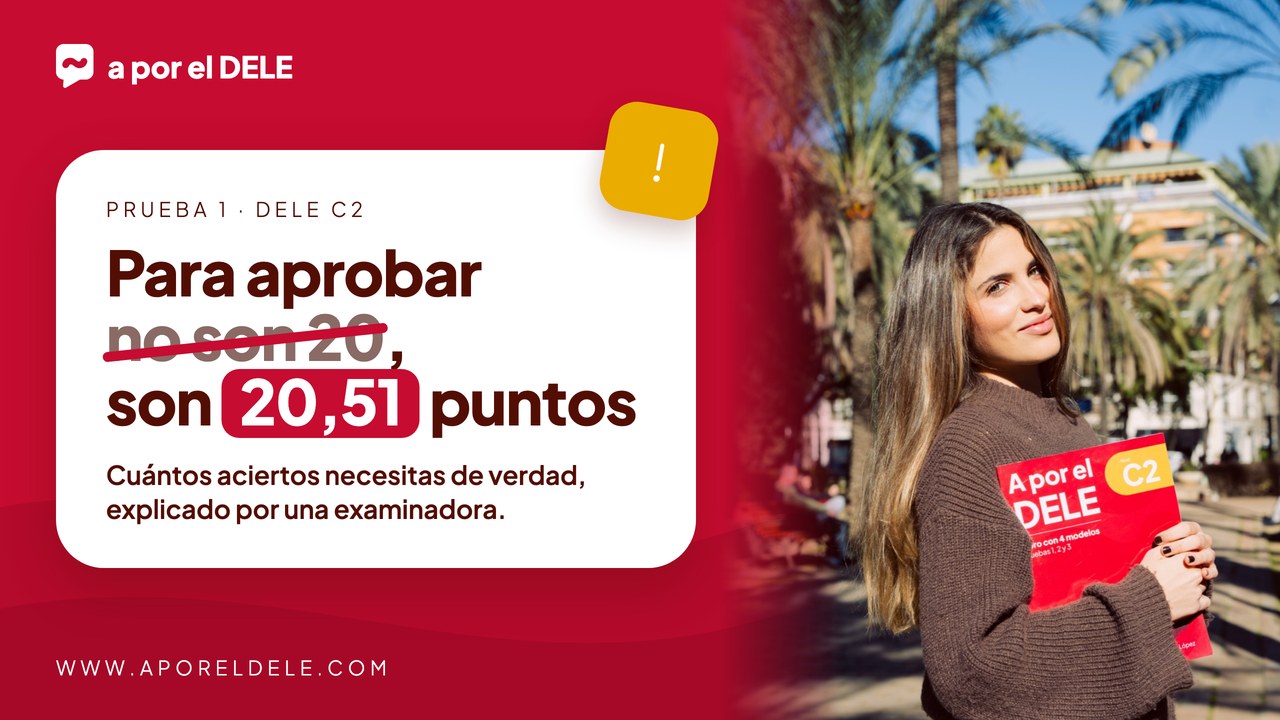
To pass this paper you need at least 60 % of the marks (20 of the 33.34 points), and at C2 each paper is passed separately: it can't be offset by the others.
How has Task 3 worked since 2024?
With the 2024 update of the C2, the Instituto Cervantes strengthened the interactive nature of this task. It's no longer just about discussing several headlines: you have to select one of them to take into a specific situation and prepare the discussion between the two of you.
This is how it goes:
- The sheet. The interviewer explains the task and gives you a sheet with the instructions and two headlines, each with a short text underneath. You don't get to choose the task: you get whatever topic you're given.
- The situation. The instructions tell you what roles you both have (for example, colleagues in a department, teachers at a staff meeting, members of a club or of the town council) and what you need to choose a headline for (to open a debate, to bring to a meeting, and so on).
- The criteria. The first part of the task includes some criteria for choosing the headline. They tend to repeat themselves with small variations: that the news story allows you to explore the topic in depth, that it's relevant and eye-catching for the people you'll discuss it with, and that it allows you to deal with issues that are close to home or topical.
- One minute to read. Before you start, you have one minute in silence to read the sheet.
- First part, about 2 minutes. You talk about both headlines and agree on which one to choose, taking into account the situation and the criteria.
- Second part, about 4 minutes. You discuss the chosen headline in depth: the topic, your opinions, examples, consequences. The move from one part to the other is smooth, with no clear break.
One important detail: the sheet stays in front of you the whole time and you can point to the headline you're talking about, but you can't write on it. And it's not a good idea to hide behind it either: if you never look up from the paper, they may call your attention to it or even take it away.
Why is Task 3 so daunting?
Task 1 is prepared during the 30 minutes beforehand and Task 2 follows on from Task 1. Task 3 is different for several reasons:
- The headlines appear right there and then, and the topic is new.
- You only have one minute to read the sheet and get your bearings.
- It isn't an interview, it's a dialogue: you're expected to take the initiative too, ask questions and steer.
- The interviewer may argue for the other headline or disagree with you so that you genuinely have to negotiate.
- You have to sustain a high register in a conversation that happens almost in real time.
The good news is that Task 3, like the others, can be trained. And you train it with two things: demanding press reading and a solid repertoire of expressions for interacting with elegance.
What is assessed in Prueba 3?
There are two people in the room. The interviewer talks to you and gives you a holistic mark, an overall assessment of your performance worth 40 % of the grade. The assessor doesn't take part and applies an analytic scale, worth the remaining 60 %. Since 2024, that scale has these categories:
- Fluency. Do you speak naturally, at a sustained pace, with clear pronunciation and intonation that carries the nuances?
- Accuracy. At C2 you're allowed the odd slip, but very clean grammar is expected even in complex structures.
- Range. A broad repertoire, lexical variety, complex structures and a flexible register.
- Task fulfilment, with different descriptors for each task: mediation in Task 1, interview in Task 2 and interaction in Task 3. In the latter: can you take and give the floor, justify your opinions, take the criteria into account, work together to reach an agreement and keep the conversation going without all the weight falling on the interviewer?
Each category is marked from 0 to 3, and band 2 corresponds to what's expected at C2 level.
Bear this in mind: if the interviewer disagrees with you, it's nothing personal. They're trying to put you in a situation where you have to defend, nuance and concede with judgement. It's the nature of the task.
How do you approach Task 3 step by step?
Step 1: in the minute of reading, start with the two headlines. Read only the bold text. In a few seconds you'll know what each one is about.
Step 2: find your role and the “what for”. You don't need to read the instructions from start to finish, because their structure repeats, but do check who you both are and what you have to choose the headline for. That “what for” has to guide the whole conversation.
Step 3: go over the criteria. Learn them at home and check whether they've changed. During the dialogue, mention them explicitly: that shows you're fulfilling the task.
Step 4: read the full headlines and decide which one you prefer. Look at the slant of each: “El turismo arrasa los centros históricos” is not the same as “El turismo dinamiza la economía local”. Notice the verbs, the adjectives and the emotional charge, and start thinking about which one you'd like to discuss afterwards.
Step 5: negotiate and reach an agreement. Talk about both headlines, justify your preference with the criteria and ask for the interviewer's opinion. You can change your mind, but explain why. What matters is that within about two minutes you settle on one. For example: “El primero me parece más llamativo para el claustro, pero el segundo permite profundizar mucho más en el tema y conectar con lo que viven los alumnos. Por eso propondría quedarnos con el segundo, ¿qué te parece?”.
Step 6: discuss the chosen headline in depth. Give your opinion, add examples, raise consequences, bring in a sub-topic and pass the ball back with questions. Practise active listening: pick up on something the interviewer has said to confirm it, nuance it or add to it.
Which expressions help you hold your position without sounding inflexible?
One of the keys to C2 is knowing how to say “no estoy de acuerdo” without it sounding like a door slamming. Here's a repertoire worth having internalised.
To present your position:
- Personalmente, soy de la opinión de que…
- A mi juicio…
- Desde mi punto de vista…
- Tal y como yo lo veo…
- Soy partidario/a de…
- Me inclino a pensar que…
To hold it when they push back:
- Entiendo el argumento, pero sigo pensando que…
- Reconozco el matiz; sin embargo…
- Aun así, no acabo de ver claro que…
- Comparto parcialmente esa idea, pero me reafirmo en…
- Sigo sosteniendo que…, por las razones que mencionaba.
- No me parece que ese argumento invalide del todo lo que planteaba.
To reinforce:
- Y a esto habría que añadir que…
- Es más…
- Conviene no perder de vista que…
- No olvidemos que…
To propose and close the agreement:
- Si te parece, podríamos quedarnos con…
- Teniendo en cuenta que lo que buscamos es…, yo me decantaría por…
- Creo que el que mejor cumple el criterio de… es…
- Entonces, ¿estamos de acuerdo en que…?
These expressions, delivered calmly, are what separate a C2 from a high C1. It's not only what you say, it's how you modulate it.
How do you concede without losing face?
Conceding well is an art, and in a task whose goal is to reach an agreement, it's essential.
- Tienes razón en parte, aunque yo lo enfocaría de otro modo.
- Es un punto válido, no lo había considerado así.
- Cierto, esa matización es pertinente.
- Concedo que…, aunque sigo pensando que…
- Visto así, sí, aunque me sigue chirriando que…
- Acepto el matiz; en lo esencial, sin embargo, mantengo mi postura.
Notice something: almost all these formulas share the same structure. I acknowledge something in the other person's point and then I nuance it. That's elegant negotiation.
How do you pick up the thread or steer the conversation back?
Sometimes the interviewer sidetracks you or interrupts you. You need to know how to get back on track.
- Volviendo a lo que decía antes…
- Si me permites retomar el hilo…
- Insistiría en un punto que mencionaba al principio…
- Por volver a la cuestión de fondo…
- Aunque ese es un tema interesante, no querría perder de vista…
- Lo que estaba planteando, en realidad, era…
How do you disagree openly but politely?
The C2 expects you to be capable of a grown-up debate. But the key word is courtesy.
- Permíteme discrepar en este punto.
- Me cuesta seguir ese razonamiento.
- No comparto en absoluto esa lectura, aunque entiendo de dónde viene.
- Discrepo profundamente, y te explico por qué.
- Me temo que ahí no podría estar más en desacuerdo.
- Con todos mis respetos, creo que el argumento es más débil de lo que parece.
These formulas are firm but polite: they let you say no loud and clear without losing your elegance.
How do you raise your register without sounding artificial?
A common trap at C2 is trying to sound “very cultured” and ending up sounding artificial. The C2 high register isn't about throwing in obscure words. It's:
- Precise vocabulary (not “muchas cosas”, but “una serie de factores”, “diversos aspectos”).
- Varied connectors (“no obstante”, “ahora bien”, “dicho lo cual”, “en otro orden de cosas”, “huelga decir que”).
- Syntax with natural subordination (relative, conditional and concessive clauses).
- Modulation: don't state things flatly, nuance them (“tiendo a pensar”, “no acabo de ver”, “en cierto modo”).
- Cultured vocabulary when it fits, not just for the sake of it (idiosincrasia, paradigma, dicotomía, en aras de, soslayar, en detrimento de, redundar en).
Quick trick: if you hear yourself saying “muy importante” or “muy bueno” three times, you're sounding flat. Swap them for “de notable relevancia”, “particularmente sólido”, “de gran calado”.
Which typical mistakes should you avoid in the C2 speaking test?
Never actually choosing a headline. If you keep discussing both without deciding, you don't complete the first part of the task. Propose, negotiate and close: “Entonces, nos quedamos con el primero”.
Forgetting the situation and the criteria. The “what for” and the criteria on the sheet need to appear in your arguments.
Turning the dialogue into an interview. If you only answer what you're asked, the weight of the conversation falls on the interviewer. Ask, propose, bring in sub-topics.
Giving opinions without justifying them. “Me gusta más el segundo” isn't enough. Always say why.
Talking a lot without structure. The C2 requires organised speech, in a conversation too.
Sounding flat in the negotiation. Saying “sí” or “no” without modulating. At C2 they expect “tiendo a coincidir, aunque con matices”, not “sí, vale”.
Calques from other languages. “Tomar una decisión”, not “hacer una decisión”; “estoy de acuerdo”, not “soy de acuerdo”.
Taking it personally. If the interviewer pushes back, don't get defensive. It's part of the task.
Forgetting courtesy. “Permíteme discrepar”, “con todos mis respetos”, “sin ánimo de polemizar, pero…”. At C2 this isn't optional.
How do you make the most of the 30 minutes of preparation?
The preparation is for Task 1 (and, along the way, for imagining the Task 2 questions). One way to split it:
- First 3 minutes: read the instructions carefully and set up the skeleton of your outline on the sheet: a space for the introduction, one for each point you're asked to cover, one for the conclusion and a corner for discourse markers.
- Next 12 minutes: read the texts and graphs and note in each space only what answers that point. Don't write full sentences, just key words, and on your sheet, not on the booklet, which as a rule you can't mark.
- Another 12 minutes: link up the information from the different materials and map out on your sheet the route of your presentation, from one point to the next.
- Last 3 minutes: prepare the introduction and the conclusion. If you have any time left, or while you wait to go in, think about what you might be asked in Task 2 and about your own opinion, because you'll be asked for it.
You can't prepare anything there for Task 3, but you can mentally warm up the repertoire of expressions we've seen. If you want to see how to approach the monologue, I explain it in how to do the Task 1 monologue in the DELE C2.
How can you train for Task 3 at home?
One: read the Spanish press. Editorials, opinion columns, op-eds. Underline the expressions that catch your eye and keep your own notebook.
Two: practise the full sheet. Take two headlines on the same topic, invent a situation (who you are and what you're choosing for) and apply the three usual criteria. Give yourself one minute to read, two to decide and four to discuss. Record yourself and listen back to spot fillers, repetitions and gaps.
Three: simulate the interaction. Ask someone to play the interviewer: have them argue for the other headline, interrupt you and make you justify yourself. If there's no one around, argue for one headline first and then for the other.
If you'd like to see a complete sheet like the ones in the exam, here's a DELE C2 speaking test sample in PDF.
Frequently asked questions about Prueba 3 of the DELE C2
How long does Prueba 3 of the DELE C2 last?
About 20 minutes in the exam room, plus 30 minutes of preparation beforehand for Task 1. Each of the three tasks lasts about 5-6 minutes.
How many headlines are there in Task 3 and what do you do with them?
Two headlines, each with a short lead text, on the same topic. First you have to choose one of the two for the situation set out on the sheet, taking into account its purpose and the criteria, and then discuss it in depth.
Can I take notes during Task 3?
No. You can't write on the sheet. You have one minute to read it in silence, and during the conversation you can look at it and point to the headline you're talking about, but you shouldn't hide behind it.
What if I don't know anything about the topic of the headlines?
You don't have to be an expert. What's assessed is your linguistic ability to reason, nuance and negotiate, not encyclopaedic knowledge. If the topic isn't your strong point, admit it gracefully (“no soy una voz autorizada en este asunto, pero…”) and give your honest opinion.
How do I avoid going blank if the interviewer puts me under pressure?
Fall back on bridge phrases: “déjame pensar un instante”, “esa es una pregunta que merece reflexión”, “permíteme reformular la idea”. They buy you two or three seconds and keep you fluent. And breathe: the pressure is part of the test.
Should I contradict the interviewer even if I agree with them?
Not as a matter of course. But it's worth showing you can nuance even when you agree on the essentials: “Estoy de acuerdo en el fondo, aunque querría matizar que…”. And remember that, by the end of the first part, you have to agree on one headline.
Is the C1 speaking test very different from the C2?
Yes. At C1 you're asked to speak accurately and fluently. At C2 you're asked for mastery: precision, lexical range, modulation and, above all, the ability to interact and negotiate when someone pushes back.
In short
- Prueba 3 of the DELE C2 is three spoken tasks in about 20 minutes, plus 30 minutes of preparation for Task 1.
- Task 3 has two headlines and a situation: first you agree on which one to choose according to its purpose and the criteria (about 2 minutes), then you discuss it in depth (about 4).
- You have one minute to read the sheet; you can't write on it.
- It's a dialogue, not an interview: justify, ask, propose and steer.
- Train a repertoire for presenting, holding your position, conceding, closing agreements and disagreeing politely.
- High register isn't obscure vocabulary: it's precise vocabulary, varied connectors and modulation.
- To pass, you need at least 60 % in this paper.
If you want to prepare task by task, my DELE C2 course gives you strategies for each paper, annotated examples, a community, a Q&A chat and group calls.
If you're still unsure whether to sit the C1 or the C2, take the level test first to get your bearings.
And if you'd like reminders before each exam session and free resources, sign up for the newsletter 💌.
¡A por el DELE! 🇪🇸