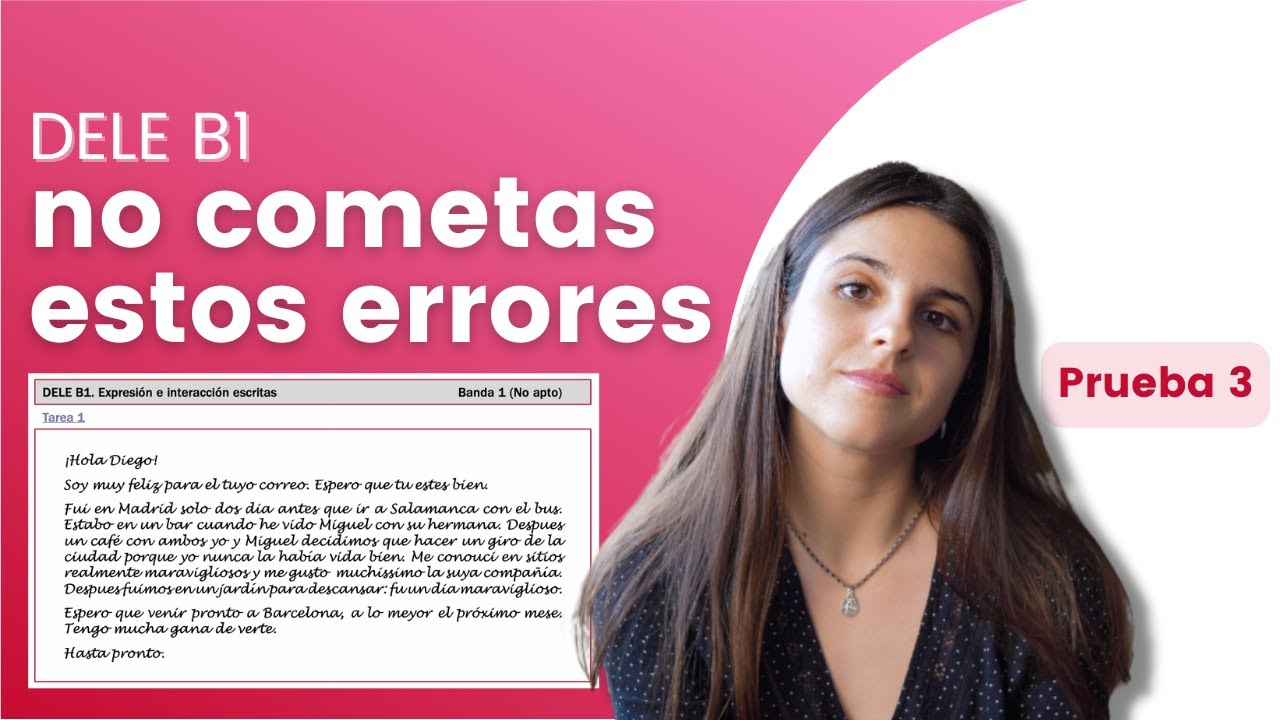
In the DELE B1 you don't fail because of one mistake, but because of a build-up of them. The text I analyse here, an example of a failed (NO APTO) text from the Instituto Cervantes model exam 0 for writing Task 1, fails for six reasons: it doesn't develop the points, the information is disorganised, it uses very few connectors, it has systematic spelling and punctuation errors, its vocabulary is limited with first-language interference, and it keeps repeating basic grammar mistakes. I go through it line by line as an examiner.
If you prefer to watch it, here's the video (in Spanish):
The task: reply to a friend's message
In DELE B1 writing Task 1 you receive a short message, usually from a friend or relative, and you reply following some points. In this model, the friend asks what you were doing in Madrid and when you plan to go to Barcelona, and the points ask you, among other things, to explain the reasons for your trip to Madrid and say when you plan to go to Barcelona.
Read the message and the points carefully and underline the key words. The points often match the questions in the message, but not always: there may be questions that aren't in the points, or points that don't appear as a question.
The 6 reasons this text fails
- 1. It doesn't develop the points enough. For example, it never explains why the writer went to Madrid.
- 2. The information is disorganised. Some sentences need rereading to be understood.
- 3. It uses very few connectors. Aim for at least four per task.
- 4. Systematic punctuation and spelling errors. There are almost no accents.
- 5. Limited vocabulary and first-language interference. You can spot literal translations.
- 6. Repeated grammar mistakes. Agreement errors and memorised expressions used wrongly.
The analysis, line by line
Greeting and sign-off
It has a letter structure: greeting, body and sign-off. Good. But in Spanish the name is separated by a comma (“Hola, Diego”), and after the sign-off you add a comma and the writer's name (“Hasta pronto, Mar”). Also, the whole body is one long paragraph: split it into short ones.
“Soy muy feliz para el tuyo correo”
Three mistakes in one sentence: estar, not ser (it's an emotion right now, not a characteristic), por, not para (the email is the cause of the happiness, not the goal), and tu, not el tuyo. Correct: “Estoy muy feliz por tu correo”. If these prepositions confuse you, read por vs para: differences and examples.
“Espero que tú estes bien”
The subjunctive is used correctly, but the accent is missing: estés. The pronoun tú can be dropped, as the verb already shows the person. If you keep it: tú (pronoun) has an accent; tu (possessive, as in tu coche) doesn't.
“Fui en Madrid solo dos dias”
Verbs of movement take a: fui a Madrid (en is for being somewhere: estuve en Madrid). And días needs an accent. The text also says how long the trip lasted, but not why, which is what the point asked for. That costs a lot of marks.
“Estabo en un bar cuando he vido Miguel”
It should be “Estaba en un bar cuando vi a Miguel”: imperfect for the ongoing action and preterite for the one-off action that happens in the middle. The past participle of ver is irregular (visto), and with people you need a: ver a Miguel. If past tenses confuse you, read the past tenses in Spanish.
“Después un café con ambos yo y Miguel decidimos que hacer un giro de la ciudad…”
This sentence has to be read two or three times: the word order is jumbled and verbs are missing. A correct version: “Después de tomar un café, Miguel y yo decidimos dar una vuelta por la ciudad, porque yo nunca la había visto”. Hacer un giro doesn't work here; you say dar una vuelta (to go for a walk around).
“Me conocí sitios maravillosos y me gusto la suya compañía”
Conocerse means to know oneself; here it should be descubrí sitios maravillosos (I discovered wonderful places). Me gustó needs an accent (without it, me gusto means “I like myself”). And the correct possessive is su compañía, not la suya compañía, a structure that reveals the writer's first language.
Repetition
Después and maravilloso are repeated. Vary with luego, más tarde, a continuación, and with estupendo, fantástico or genial.
“Espero que venir pronto”
With the same subject, use the infinitive without que: espero ir pronto. With different subjects, que + subjunctive: espero que tú vengas. And watch ir vs venir: you go to Barcelona, because you're moving towards it. To review the subjunctive, read 7 subjunctive mistakes that cost you marks in the DELE B1.
“A lo mayor el proximo meses”
The expression is a lo mejor (maybe). Próximo needs an accent and the singular is mes: a lo mejor el próximo mes.
How it could have passed
At B1 you're allowed some mistakes. The problem is when they repeat, get in the way of understanding and add up with other issues: repeated words, no connectors and a missing point. These changes would improve the text a lot:
- Cover every point, including the reasons for the trip.
- Organise the text in short paragraphs.
- Add markers such as para empezar, por un lado, por otro lado, además, entonces, por eso.
- Check accents, agreement and basic prepositions.
- Include a colloquial expression, like “fue un día genial”.
To see a text that works, read the DELE B1 informal letter: model and structure.
FAQ
Do you fail the DELE B1 writing test because of one mistake?
No. You fail because of the build-up of systematic mistakes, missing points, lack of connectors and organisation problems.
How many connectors should I use?
Aim for at least four per task.
Do accents count in the DELE B1?
Yes. At B1 you're expected to master them, and leaving them out systematically costs marks.
What if I answer the questions in the message but not the points?
The points are what's assessed. Answer all of them and focus on them.
Summary
- Read the message and the points, and cover every point.
- Organise the information in short paragraphs.
- Use at least four connectors.
- Watch accents, ser vs estar, por vs para, possessives and prepositions with verbs of movement.
- Avoid repeated words and literal translations.
Resources to prepare for the DELE B1
In my online course I go task by task explaining what to do and what not to do, with tips to get a better score, a student community and a chat where you can ask me anything at any time. Access is immediate and for life: online DELE B1 course.
To practise with full exams: A por el DELE B1, 4 exam models with answers.
For free resources and reminders before each exam session, join the newsletter: recursos.aporeldele.com/boletin.
¡A por el DELE! 🇪🇸