
If you're preparing for the DELE B2 and you've been told "you have to use more connectors", but you don't know which ones, when or how, I understand you. It's one of the most repeated complaints among my students and one of the areas where it's easiest to gain marks with little effort. The good news is that a closed list of well-used connectors is enough to raise the level of your writing and your oral presentation.
In this article I'm giving you the DELE B2 conectores (connectors) that will really serve you, organised in a table by function. It's not an endless list. They're the ones that make the difference. Let me walk you through it.
Why connectors are the silent key to the DELE B2
At B1 it's enough to write correct sentences that are more or less strung together. At B2, it isn't. At B2 you're asked to produce a text with cohesion, a text that clearly reads as thought through, not as a list of sentences. In fact, in the scales used to mark the exam, coherence (which includes connectors and other cohesive devices) has its own section: it's not an extra, it's part of your grade.
This means the examiner is looking for three things:
- That your ideas are logically connected to each other.
- That you use varied resources, not always the same "y" or "pero".
- That your connectors are well placed and mean what you think they mean.
And here comes the typical problem: many candidates memorise a huge list and then drop in "no obstante" where "por tanto" belongs, or "en cambio" where "sin embargo" belongs. Result: the text sounds odd and loses marks. It's a very common mistake (coherence, which includes using connectors well, is one of the criteria your text is scored on: I explain how they work in how the DELE is graded).
That's why I'm not going to give you 80 connectors, just the ones that are actually used.
Table of DELE B2 connectors by function
Here's the organised summary. Print it, stick it on the wall, take a photo of it. Further down I'll explain how to use each group.
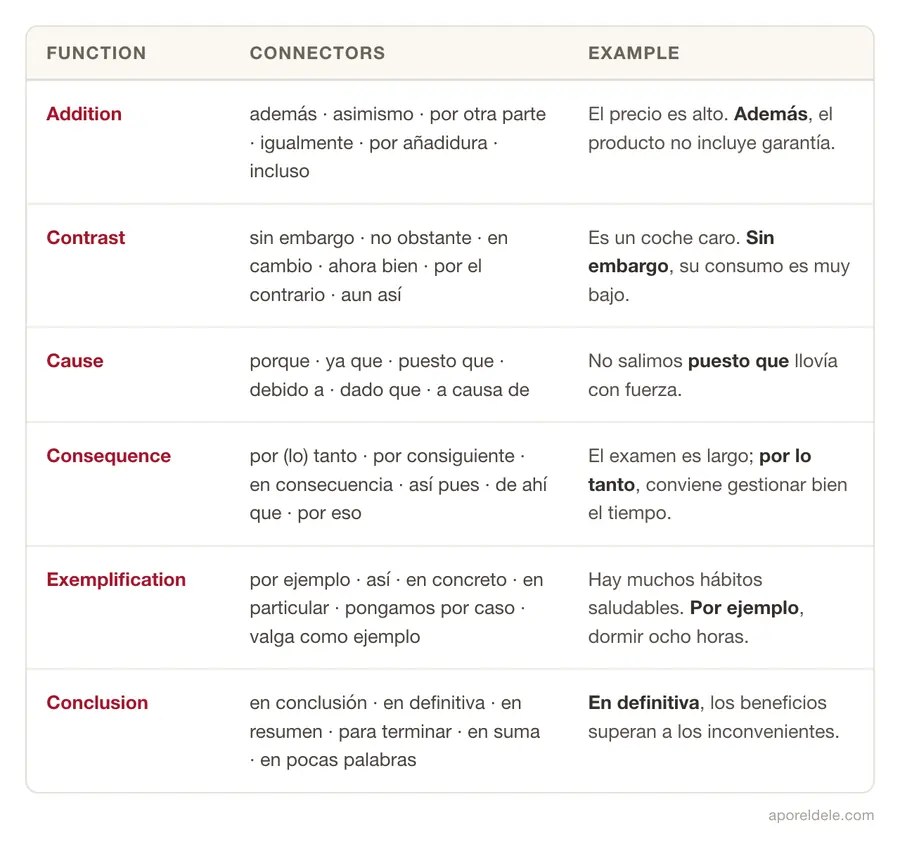
That table is the backbone. If you master four or five connectors from each group, you already have a more than sufficient repertoire for the B2.
How to use addition connectors without falling into "además, además, además"
The classic mistake: starting every sentence in a paragraph with "además". It gets tiring, it sounds poor and it's obvious straight away that you only really handle one.
Varying pays off. Look at this progression:
❌ "El curso es online. Además, es flexible. Además, es económico. Además, tiene tutoría."
✅ "El curso es online. Además, es flexible. Por otra parte, resulta económico. A esto se suma una tutoría personalizada."
It's worth saving "asimismo" and "igualmente" for more formal registers (written Task 1, opinion articles). "Por otra parte" works almost always. "Incluso" adds a nuance of intensification: use it when what comes next is your strongest point.
Quick trick: in every B2 piece of writing, set yourself a maximum of two "además". It forces you to look for alternatives.
Contrast connectors: the "sin embargo" and "no obstante" trap
This is where I see the most slip-ups. Many candidates think "sin embargo" and "no obstante" are interchangeable. And they almost are, but it's worth fine-tuning:
- "Sin embargo" works in almost any register. It's the safe option.
- "No obstante" is more formal and usually appears at the start of the sentence, set off by a comma.
- "En cambio" introduces a comparative contrast between two different things, not between one thing and its opposite.
- "Ahora bien" introduces a qualification, a twist on what has just been said.
Look at the difference:
❌ "Me gusta el café. En cambio, no me gusta amargo." (There aren't two comparable elements here; it's a qualification.)
✅ "Me gusta el café. Ahora bien, no lo tomo amargo." (Qualification.)
✅ "Me gusta el café. En cambio, a mi hermano le gusta el té." (Comparison between two people.)
Watch out for this: if you use "sin embargo" three times in the same written task, alternate. Slip in a "no obstante" or an "aun así" and your text goes up a level with that alone.
Cause connectors: when to use "porque", "ya que" or "puesto que"
All three mean more or less the same, but they aren't used the same way:
- "Porque" is the most neutral. It almost always works. It usually goes in the middle of the sentence.
- "Ya que" introduces a cause that is known or obvious to the reader. It goes at the beginning or end of the sentence, set off by a comma.
- "Puesto que" and "dado que" are more formal. Excellent for written Task 1.
- "Debido a" and "a causa de" are followed by a noun; if you put a full clause after them, you need "que" (debido a que, a causa de que). This gets mixed up a lot.
❌ "Debido a llueve no salimos." (Missing "que" or a noun.)
✅ "Debido a la lluvia, no salimos."
❌ "A causa de hace frío no salimos."
✅ "A causa del frío, no salimos."
Memorise this: "debido a" + noun, "porque" + clause. If you have that clear, you save yourself a lot of mistakes. And if you want to go deeper into all the ways of expressing cause, there's a whole post on causal clauses for the DELE B1 and B2.
Consequence connectors: give your conclusions real force
Here you have a lot to play with. Consequence connectors are the ones that order your argument. Without them, your text looks like a list of loose ideas:
- "Por (lo) tanto" is the workhorse. It works for everything (and remember: it's set off by commas almost always).
- "Por consiguiente" and "en consecuencia" are more formal. Ideal for Task 1.
- "Así pues" usually closes off a line of reasoning.
- "De ahí que" requires el subjuntivo (the subjunctive) after it. This is important and it's often forgotten.
❌ "Estudia mucho, de ahí que aprueba." (Indicative, wrong.)
✅ "Estudia mucho, de ahí que apruebe." (Subjunctive, right.)
If you use "de ahí que + subjuntivo" once in your B2 written task, you demonstrate a clearly B2 level. It's one of those details that stand out when marking.
Exemplification connectors: variety without effort
If throughout your whole B2 text you say "por ejemplo, por ejemplo, por ejemplo", it sounds poor. And, once again, you have alternatives:
- "Por ejemplo" is the universal option.
- "En concreto" and "en particular" serve to introduce a specific case within something broader.
- "Pongamos por caso" is colloquial but valid in texts that aren't too formal.
- "Valga como ejemplo" is very formal; it looks very good in a Task 1 if it fits.
❌ "Hay muchos deportes que practico. Por ejemplo, correr. Por ejemplo, nadar. Por ejemplo, montar en bici."
✅ "Hay muchos deportes que practico, en particular correr y nadar. También monto en bici de forma habitual."
Replacing "por ejemplo" with a structure like "en particular" or "concretamente" improves the text straight away.
Conclusion connectors: how to close a written task or an oral turn well
Closing well matters enormously. It's the last thing the examiner reads and it leaves the final impression:
- "En conclusión" is the safe option, formal and clear.
- "En definitiva" carries a nuance of "after everything that's been said, this is what matters". Very useful.
- "En resumen" gathers up ideas. It works, but it sounds a bit school-essay.
- "En suma" is elegant, formal, ideal for Task 1.
- "En pocas palabras" is more colloquial. For Task 2 or the oral exam.
- "Para terminar" announces the close. It gives the reader or listener notice.
❌ (A text that ends abruptly with no transition): "...y por eso es importante reciclar. Las botellas son lo peor."
✅ "...y por eso es importante reciclar. En definitiva, pequeños gestos cotidianos pueden tener un gran impacto si los hacemos todos."
B2 discourse markers: how they differ from connectors
An important note, because there's some confusion here. Conectores (connectors) are one type of marcador discursivo (discourse marker), but discourse markers also include other things:
- Information organisers (en primer lugar, por un lado, finalmente).
- Reformulators (es decir, en otras palabras, dicho de otro modo, mejor dicho).
- Discourse operators (en realidad, de hecho, en cualquier caso, por cierto).
- Conversational markers (bueno, hombre, claro, mira).
For the DELE B2 you're mainly interested in the first three groups in the written exam and all four groups in the oral exam. You don't need to memorise them all. What matters is that you recognise they exist and use them naturally. You'll find more discourse markers, with examples for every level, in this other post on discourse markers for the DELE.
Connectors for the DELE B2 written exam
The written exam has two tasks. Each one has its own register and, therefore, its own type of connector:
- Task 1 (formal letter based on an audio): formal register. This is where "no obstante", "puesto que", "asimismo", "por consiguiente", "en suma" and "cabe destacar" shine.
- Task 2 (argumentative text based on an option): semi-formal register. Here "sin embargo", "además", "por ejemplo", "por tanto", "en definitiva" and "ahora bien" work well.
Quick trick: prepare a mental cheat sheet with five connectors for each task. Five you truly master. Not 25 badly used.
Connectors for the DELE B2 oral exam
In the oral exam, connectors stand out less if you memorise them. But conversational markers do count, and a lot:
- Giving an opinion: en mi opinión, desde mi punto de vista, yo creo que, a mí me parece que (here are 8 expressions for giving your opinion without saying "creo que").
- Arguing: por eso, ya que, lo que pasa es que, además.
- Adding nuance: ahora bien, eso sí, aunque también.
- Reformulating: o sea, es decir, quiero decir.
- Closing an idea: en fin, bueno, en definitiva.
A B2 candidate in the oral exam doesn't use "no obstante" every other sentence (it would sound artificial). They use "pero", "aunque" and "ahora bien". And that alone shows level. A natural example: "A mí me parece que el teletrabajo tiene muchas ventajas. Eso sí, hay que saber organizarse, porque si no, acabas trabajando más horas". Three markers, zero stiffness. If you want to see what the whole test looks like, here's what the DELE B2 oral exam is like.
Examples of B2 connectors in a piece of writing (with commentary)
Look at this extract from an argumentative Task 2 on remote working:
"El teletrabajo se ha consolidado en los últimos años como una opción real para muchos profesionales. Ahora bien, conviene analizar sus ventajas y sus inconvenientes con cierta calma. Por un lado, ofrece flexibilidad horaria y permite conciliar mejor la vida personal. Además, supone un ahorro evidente en desplazamientos. Sin embargo, también plantea problemas: el aislamiento, la dificultad para desconectar y, en ocasiones, una sobrecarga de trabajo. Por consiguiente, no es una solución mágica. En definitiva, el teletrabajo puede ser una herramienta valiosa si se regula bien y si cada persona aprende a poner límites."
Notice: in under a hundred words there are six different connectors and every single one is in its place. That's what the examiner is looking for in a B2 Task 2.
Typical mistakes with connectors in the DELE B2
These are the most common ones, and they're worth avoiding:
- Confusing "sin embargo" with "aunque". "Aunque" introduces a concession and goes inside the sentence. "Sin embargo" introduces an opposition and goes at the start.
- Using "por lo tanto" without commas. It almost always takes a comma before and after.
- Repeating "pero" when you could use "sin embargo" or "no obstante".
- Placing the connector in the middle of the sentence when it should go at the start (and the other way round).
- Forgetting the subjunctive after "de ahí que".
Frequently asked questions about DELE B2 connectors
How many connectors do I have to use in a DELE B2 piece of writing?
There's no magic number, but as a reference: in a task of 150-180 words (the real length of the B2 written tasks), between 4 and 6 varied connectors is reasonable. More doesn't mean better. Better means used with good judgement. Think of it as one or two per paragraph: one to link back to the previous idea and, at most, another inside the paragraph. A quick way to check: if you reread your text and find three sentences in a row with no link between ideas, a connector is probably missing; if every sentence starts with one, there are too many.
Can I use the same connectors in the oral exam and the written exam?
Some yes, others no. "Sin embargo" or "además" work in both. "No obstante" or "asimismo" sound stiff in the oral. For speaking, use the most natural ones: pero, aunque, así que, por eso, total que. The practical rule is simple: if you wouldn't use a connector in a real conversation with a Spanish-speaking friend, don't use it in the oral exam either. In the written exam it's the other way round: there it does pay to raise the register, especially in Task 1.
How do I memorise the connectors so I don't forget them on exam day?
Better than memorising lists: use them when you write or speak. Every time you do a practice piece of writing, set yourself the rule of using at least one connector from each function. Within three or four pieces of writing they'll stick. Another technique that works very well: write your own sentence with each connector on the typical exam topics (work, technology, the environment, health). On exam day you won't be retrieving a single word but a whole structure you've already used.
Which connectors impress the examiner most?
More than impressing, what matters is that they're well placed. But if I have to single out three that clearly demonstrate B2 level: "de ahí que + subjuntivo", "no obstante" at the start of a sentence, and "cabe destacar" in a formal task. Why these three? Because they demand grammatical control (the subjunctive), a feel for register (the formality of "no obstante") and vocabulary typical of formal texts ("cabe destacar"). They're hard to use well by accident, and that's exactly what makes them valuable.
Do connectors count towards the word count of the task?
Yes. Everything you write counts, connectors included. That's why it's best not to pad with empty connectors: each one has to earn its place. That said, don't cut them out for fear of going over the word count either: a well-connected text of 180 words is worth more than a disjointed one of 150.
Is it better to have a text with a few well-used connectors or lots used so-so?
By far, a few well used. A text overloaded with badly placed connectors sounds worse than a simple, well-connected one. The examiner values coherence, not inventory. In fact, a badly used connector can confuse the reader and damage the coherence of the text, which is another of the scoring criteria. A well-used one, on the other hand, makes the ideas move forward on their own.
Do these connectors also work for the DELE B1 or C1?
The core ones do, but each level asks for something different. At B1 you can get by with less variety: if you master "además", "sin embargo", "porque", "por eso" and "en conclusión", you're well covered. At C1, on the other hand, more precision and more range are expected: connectors like "si bien", "con todo" or "en cualquier caso" used with ease start to make the difference. This table is designed for the B2, the level where connectors go from being decoration to being a decisive criterion.
The essentials
- Connectors are the backbone of your B2.
- Master the table by function: addition, contrast, cause, consequence, exemplification, conclusion.
- Don't repeat the same connector three times in the same text. Vary.
- "De ahí que" requires the subjunctive. If you've got it under control, you show level.
- In the oral, use natural markers: pero, aunque, eso sí, ahora bien.
- Better five connectors you master than twenty that just ring a bell.
If you want to work on the DELE B2 task by task, with connector templates adapted to each part of the exam and annotated examples, you'll see it all in a practical way in my DELE B2 preparation course. If you're still not sure you have B2 level, take the free level test first to confirm it. And if you'd like to receive free resources, exam-session reminders and useful materials, sign up to the newsletter 💌
¡A por el DELE! 💪