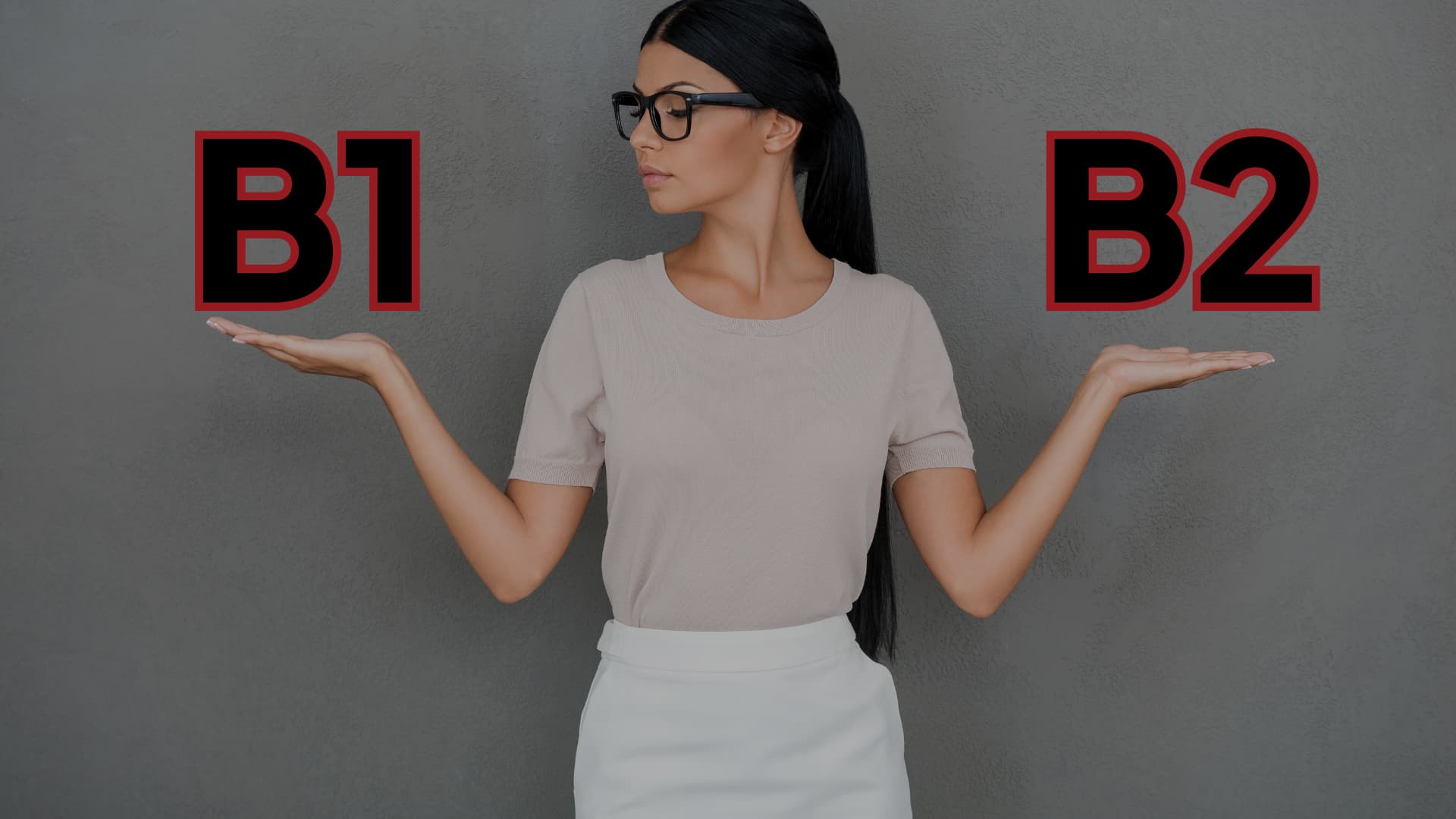
Sit the DELE B1 if you get by well in everyday situations but still struggle to argue a point, and the DELE B2 if you can already defend an opinion, follow the press and use the subjunctive with some ease. And if what you need is Spanish nationality, you don't need either of them: the DELE A2 (plus the CCSE) is enough.
“Should I sit the B1 or go for the B2?” is one of the most common doubts, and I totally understand why it keeps you going round in circles. The B1 feels safe but small, and the B2 excites you but scares you. The good news is that the decision isn't only about “how much you know”: it also depends on what you need the certificate for, how much time you have and what kind of Spanish you use day to day.
In this post you'll find a full DELE B1 vs B2 comparison: the papers, timing, grammar demands, what's assessed, price and, above all, what each certificate is good for.
Why can't an online quiz answer the “B1 or B2” question?
Many people think an online grammar quiz will tell them their level. And yes, it gives you a hint, but the DELE doesn't only assess grammar. It assesses four skills (reading, listening, writing and speaking) through specific tasks and very clearly defined criteria.
That's why, before choosing between the DELE B1 and the DELE B2, it's worth looking at two things:
- What each exam asks of you in each paper (writing 100 words is not the same as writing 180).
- What you're going to use the certificate for (a nationality application is not the same as university or a qualified job).
If you only focus on “how much vocabulary I know”, it's easy to pick the wrong level.
Before we go on, if you want a quick answer, in this video I give you a five-question test to help you decide:
How are the DELE B1 and the DELE B2 different? A point-by-point comparison
Here's the full breakdown:
- Papers: B1: 4 (reading, listening, writing and speaking) · B2: 4 (reading, listening, writing and speaking)
- Approximate length: B1: about 3 hours (reading 70 min, listening 40, writing 60 and speaking 15, plus 15 minutes of preparation) · B2: about 3 h 30 min (reading 70 min, listening 40, writing 80 and speaking 20, plus 20 minutes of preparation)
- Reading: B1: 5 tasks, everyday and semi-formal texts · B2: 4 tasks, longer texts, opinion pieces and press articles
- Listening: B1: 5 tasks, everyday audio and short news items · B2: 5 tasks, longer conversations, interviews and extracts
- Writing: B1: 2 tasks (an email or letter replying to a message, and a text where you choose between two options) · B2: 2 tasks (a letter based on an audio recording you hear twice, and a choice between commenting on a graph or writing an article, a review or a blog post)
- Word count: B1: 100-120 in Task 1 and 130-150 in Task 2 · B2: 150-180 in each task
- Speaking: B1: 4 tasks (a presentation on a topic, a conversation about that presentation, describing a photo, and a dialogue in a role-play situation) · B2: 3 tasks (assessing some proposals and discussing them, describing a situation based on a photo, and giving your opinion on survey data)
- Key grammar: B1: past tenses, future, simple conditional, basic subjunctive · B2: confident use of the subjunctive, conditional perfect, unreal conditionals, passive voice
- What's assessed: B1: getting everyday messages across correctly · B2: arguing, nuancing, using the right register and writing coherent texts
- Types of text: B1: letters, ads, personal blogs, short news items · B2: reports, opinion columns, interviews, reviews
- Price in Spain (2026): B1: €173 · B2: €204 (outside Spain, each centre sets its own price)
- What it's good for: B1: your CV, jobs where Spanish isn't your main tool, exchanges · B2: university, master's degrees, qualified work in Spanish, a professional CV
- Validity: B1: indefinite · B2: indefinite
As you can see, the difference between the DELE B1 and the B2 isn't just “more words”. It's a different kind of Spanish: more argumentative, more nuanced, with more registers.
What really changes between the B1 and the B2?
Types of text: from the friendly email to the opinion piece
At B1, the texts you read and write are mostly personal: blogs, letters to a friend, ads, short news items. The grammar revolves around talking about your life and giving your opinion simply.
At B2 you take a leap. You read opinion columns, long interviews, reports. And you're expected to write like that too: arguing, assessing, comparing points of view. “A mí me parece bien” no longer cuts it. You need to link ideas with more sophisticated connectors and add nuance.
Grammar: the subjunctive takes on a new role
At B1, the subjunctive appears in basic ways (wishes, simple purpose, “cuando + present subjunctive”).
At B2, the subjunctive takes centre stage. Unreal hypotheses with “si hubiera/hubiese”, negated opinions, the conditional perfect and relative clauses with an unknown antecedent all come in. If this sounds like Greek to you, you're still at B1.
Listening: the pace and the accents go up a level
In the B1 listening paper, the recordings are clear, with speakers talking at a calm pace and with controlled vocabulary.
At B2 you get longer recordings, interviews with people who speak faster, different accents from across the Spanish-speaking world and more specific vocabulary (economy, health, culture, society). This is where a lot of people lose their footing.
Writing: from “querido amigo” to the formal letter
At B1 you write an email or letter of 100-120 words replying to a message and then, in the second task, you choose between two options and write 130-150 words, usually about an experience or giving your opinion.
At B2, Task 1 starts with an audio recording you hear twice and, based on it, you write a letter, almost always a formal one: to complain, make a request, give your opinion or suggest changes. In Task 2 you choose between commenting on a graph or writing an article, a review or a blog post. In both tasks you write 150 to 180 words, with a clear structure, connectors and nuance.
Speaking: from “let me tell you” to “let me convince you”
At B1, the speaking test is more narrative. You present a topic, talk about it, describe a photo and handle a dialogue in an everyday situation.
At B2 the mindset changes. You have to assess proposals, describe a situation based on a photo, give your opinion on survey data and defend your point of view. It's a more grown-up conversation, with sound judgement.
What is the DELE B1 good for?
The DELE B1 certifies that you can get by in Spanish in everyday, predictable situations. It's useful for:
- Your CV, especially if your job doesn't revolve around languages.
- Entry-level positions at companies that ask for intermediate Spanish.
- Erasmus stays or exchange programmes at many universities.
- Any application that asks for a certified B1 level.
What about Spanish nationality? The B1 works too, but you don't need it: for nationality by residence, the DELE A2 or higher plus the CCSE is enough. I explain it in CCSE and DELE A2: the two Spanish nationality exams.
It's a very useful level, so don't underestimate it. For lots of people, the B1 is exactly what they need.
What is the DELE B2 good for?
The DELE B2 certifies that you can interact with native speakers without obvious effort, defend an opinion, understand the press and work in Spanish with some ease. It's the level that opens these doors:
- University studies in Spanish-speaking countries (many universities ask for at least a B2).
- Qualified jobs where Spanish is the working language (education, healthcare, customer service, translation).
- Master's degrees and advanced vocational training.
- An international professional CV.
It's the level most often requested in professional and academic settings. If you're going to live and work in a Spanish-speaking country, the B2 is very likely your realistic goal.
Which is harder, the B1 or the B2?
The B2 is clearly more demanding: longer texts, more words per task, more argumentation and a subjunctive that can no longer let you down.
That said, don't stop at “harder”. The real difference is this:
- At B1 you show that you can get by in Spanish.
- At B2 you show that you live in Spanish.
If your daily life already happens in Spanish (work, partner, studies), the B2 may go better for you than a B1 crammed in a rush. And the other way round: if you only use Spanish in class, the sensible thing is to go for the B1 and consolidate.
How do I know whether the B1 or the B2 is for me? Typical profiles
Here are some profiles so you can see where you fit.
Sit the DELE B1 if…
- You've been studying Spanish regularly for one or two years.
- You communicate in everyday situations without trouble, but you get stuck when you have to argue a point.
- You handle the present and past tenses well, but the subjunctive still feels far away.
- You need the certificate for an application, an exchange or a job where Spanish isn't your main tool.
- You want to consolidate before moving up to the B2 in a later exam session.
- Your goal is to gain confidence with a certificate before going further.
Sit the DELE B2 if…
- You've been studying for three years or more, or for less time but living in a Spanish-speaking country.
- You can read the Spanish press, even if you still need to look up some words.
- You use the subjunctive fairly naturally (even if not perfectly).
- You need the certificate for university, a master's or a qualified job.
- You've taken a recent level test and got B2 (or a very high B1).
- Your professional or academic goal requires at least a B2.
The in-between case: a high B1
If you feel “too good for the B1, too borderline for the B2”, you're still at a high B1. My advice as an examiner is clear here: either wait a few months and go for the B2 with a plan, or sit the B1 and secure the pass. Sitting a B2 you're not ready for means leaving €204 and a lot of energy behind.
Is the DELE B1 enough for your CV and for university?
It depends a lot on the context.
- For a general CV (logistics, customer service, retail, hospitality), the B1 is perfectly valid proof that you can function in Spanish.
- For sectors where Spanish is your working tool (education, healthcare, translation, communication), the B1 will fall short.
- For university entry, many universities in Spain and Latin America ask for at least a B2. Always check the requirements of the specific programme.
Do I need the DELE B2 for Spanish nationality?
No. For Spanish nationality by residence, the DELE A2 or any higher level is enough, together with the CCSE (the test on constitutional and sociocultural knowledge of Spain). The B1 and the B2 also work, but if you only need the certificate for nationality and you don't have a professional goal that requires more, sitting the B2 (or even the B1) means investing more time and money than you need to.
My honest advice as an examiner
- If you're genuinely unsure, start with a serious level test, with tasks like the ones in the exam.
- If you come out clearly B1, don't force the B2. Pass the B1, gain confidence and prepare the B2 on a solid base.
- If you come out as a borderline B2 or a very high B1, look at how much time you have before the exam session. With three or four months of steady preparation, many people move from a high B1 to a solid B2.
- If you come out clearly B2, go for the B2 without looking back. The B1 would fall short on your CV.
There's no universal answer, there's an answer for your situation. And to find it, look at three things: your real level, your goal and the time you have.
Frequently asked questions about the DELE B1 vs B2
Can I sit both exams in the same session?
It doesn't usually make sense: in each exam session, the written papers for the different levels take place on the same date, so in practice you'd have to choose. And even if you could, studying for two levels at once spreads you too thin. It's better to focus on one.
If I pass the B1, do I need to take it again before sitting the B2?
No. DELE levels are independent. You can sit the B2 directly without having taken the B1, and vice versa.
How long does it take to go from B1 to B2?
It depends a lot on your foundation, how much Spanish you hear and use, and how you study. As a rough guide, between six months and a year of regular work. If you live in a Spanish-speaking country, it can be faster.
Is the speaking test very different at B1 and B2?
Yes, quite. At B1 there are 4 tasks and you mainly present, narrate and describe; at B2 there are 3 tasks and you're asked to argue and assess. The preparation time changes too: 15 minutes at B1 and 20 at B2.
What level do I need to study in Spain?
Many universities ask for a certified B2 for official degrees, although some programmes accept other levels. Always check the specific requirements of the programme you're interested in.
Do DELE certificates expire?
No. DELE diplomas (B1, B2 and every other level) are valid indefinitely. Once you pass, it's yours for life.
In short
- The DELE B1 certifies that you function in everyday Spanish; the B2, that you live in Spanish with sound judgement.
- The B2 is clearly more demanding, especially in writing and speaking, and requires a good command of the subjunctive and of argumentation.
- For Spanish nationality, the DELE A2 plus the CCSE is enough; the B1 helps with your CV and exchanges, and the B2 opens the door to university and qualified work.
- In the writing paper, the B1 asks for 100-120 and 130-150 words; the B2, 150-180 in each task.
- If you're torn between the two, take a realistic level test before deciding.
- Don't sit a B2 you're not ready for, but if your level is there, don't settle for the B1 out of fear.
If you still don't know which level to sit, start with the level test.
If you already know you're going for the B1, my DELE B1 course gives you strategies for each paper, annotated examples, a community, a Q&A chat and group calls. If the B2 is your goal, here's the DELE B2 course, with the same things designed for that level.
If you'd rather practise the B1 on paper, I also have the book on Amazon: https://amzn.to/4e66lV6
And if you'd like free resources and useful reminders before each exam session, sign up for the newsletter 💌.
¡A por el DELE! 🇪🇸